
What Are the Rules & Regulations for Pipe ID Markers in the UK?
Date: 28/04/26
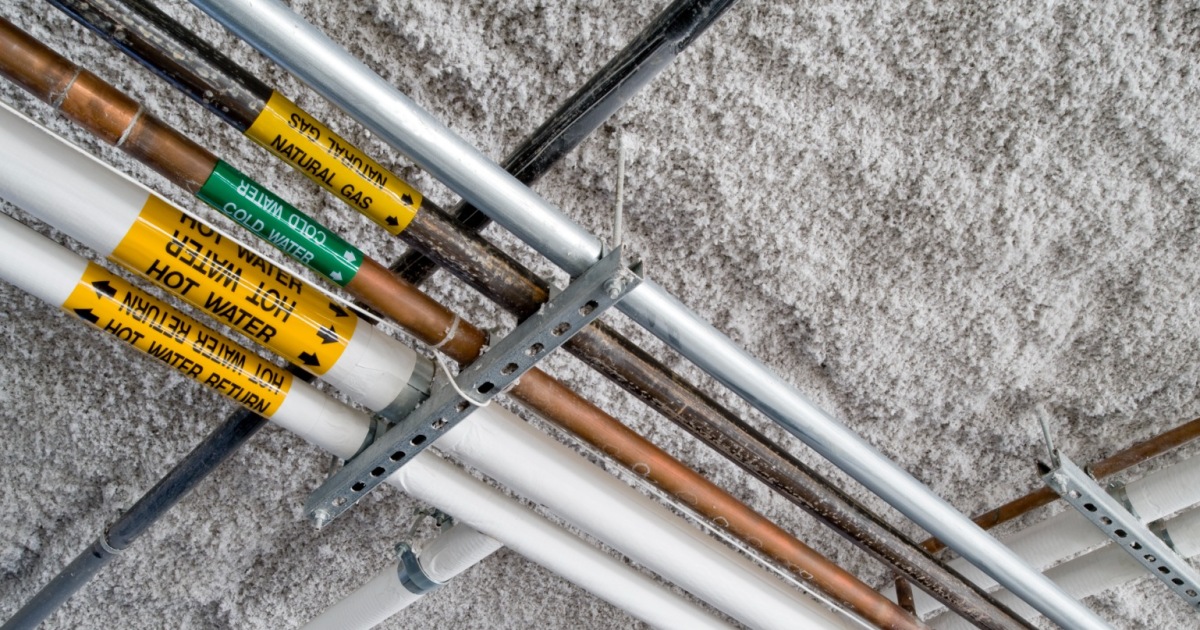
We’ve already discussed the many practical benefits of pipe ID markers in our recent article ‘Pipe Identification Tags: How to Organise Industrial Systems’. These benefits include safety, operational efficiency, ease of maintenance and assisting emergency services.
Clearly pipe ID tags are a sensible addition to any building, but are pipe ID markers mandatory in the UK? And if so, which rules and regulations apply to pipe ID markers in Britain?
In this article, we will clarify exactly where and when pipe ID markers are required by law, and what guidance is available for installation.
Are pipe ID markers required by law in the UK?
Yes, they are, but only in certain circumstances. The applicable statute is Health and Safety (Safety Signs and Signals) Regulations 1996. However, this only applies where ‘the risks to employees cannot be avoided or adequately reduced by other means’.
These regulations were reviewed in 2006 to make it clear that ‘if the risk is not significant there is no need to provide a sign.’ This review also states that ‘if inspectors consider employers have taken sufficient steps to avoid residual risks to employees… there is no need for employers to label pipes’.
However, just because you don’t have to, doesn’t mean you shouldn’t still consider labelling your pipes clearly for practical and safety reasons.
What circumstances require pipe ID markers by law?
The Health and Safety Executive gives a number of examples where pipe ID markers will be required by law, including:
-
Locations where there are numerous pipes in close proximity conveying different dangerous substances
-
Sampling or filling points and drain valves, particularly where they are located in close proximity to similar points for other pipes
-
Where there have been significant or ongoing alterations or additions to original pipe runs.
Is BS1710 a legal requirement?
No. Unlike HSE legislation, British Standards are produced as guidance on best practice and are not enforceable by law. However, they do create a standardised system of pipe ID markers that everyone can recognise and respond appropriately to.
BS1710 provides guidance on several aspects of pipe ID markers, including:
-
Colour – providing an instant visual guide as to the contents of a pipe. For example, green for water, brown for oils, yellow for gasses and violet for acids or alkalis.
-
Text – providing guidance on the colour, font and font size for the text on pipe ID markers, including the name, chemical symbols or common abbreviations, as well as hazard symbols where necessary, such as GHS pictograms.
-
Direction arrows – to show the direction of flow
Sleeve It pipe ID markers are fully compliant with BS1710, making them clear and easy to read for your maintenance team, your staff and the emergency services.
BS1710 also explains best practice in the placement of pipe ID markers, including:
-
Spacing – pipe ID markers should be placed every 6-15 meters on indoor facilities
-
Obstacles – pipe markers should be placed either side of obstacles such as walls
-
Key points – pipe ID markers should be placed close to key points in the pipework, such as junctions, valves and outlets.
Sleeve It coiled and snap-on pipe ID markers are easy to install at any point in your pipe run, and easy to maintain and replace over time.
More than just a legal requirement
Sleeve It pipe ID markers have numerous benefits beyond legal compliance, including:
-
Improving productivity and efficiency – pipe ID markers make it easier to conduct repairs and maintenance
-
Enhancing safety for operators, staff and visitors – pipe identification markers reduce accident risks, especially around hot or hazardous substances
-
Improving emergency response – clearly identified pipes make it quicker and easier for emergency services to respond appropriately in a fire or other emergency situation.
Get the simple, practical solution from Sleeve It
Sleeve It pipe ID markers provide a simple and effective solution for pipe identification that is both fully compliant and immensely practical. Whether you are legally obliged to label your pipes or you simply want to apply best practice to improve efficiency, enhance safety and support the emergency services, talk to our team today.
Frequently Asked Questions
No. Like all British Standards, BS1710 is provided as a best practice guide and is not legally enforceable. However, it does create an industry standard that enhances the benefits of using pipe ID markers.
No. The review of HSE regulations, published in 2006, clarifies that pipe ID markers are only required where ‘the risks to employees cannot be avoided or adequately reduced by other means.’
No. Pipe ID markers are only a legal requirement under certain hazardous circumstances. However, they are highly recommended in many other situations for practical and safety reasons.
You can, but it will reduce the effectiveness of your marking system. BS1710 standardises pipe ID markers so that everyone can recognise them, from maintenance crews to emergency workers.
0 Comment
Add your Comment
We have the ability to edit and/or delete posts and comments. Links should be relevant to the topics. Please note all comments are subject to review before inclusion.
Login to comment
Register to comment
Blog Archives
Sleeve It Blog

Should I Use PVC Sleeving or Silicone Sleeving?
Both PVC and silicone sleeving will deliver protection, moisture resistance, electrical insulation a...
Sleeve It Newsletter
If you would like to receive regular information via email from Sleeve It then please input your contact details below.
Nobody has commented yet. Why not add one?